

Check out this latest spat from Trump demanding US take over Canadian Ports.
SAVE TIME – HIT RED BUTTON ABOVE
Listen to a few minutes of the podcast from Warren Buffet to get the gist and then check out my summary below for the essential facts.
BREAKING Trump Pressures Canada for Control of Ports —
Warren Buffet response
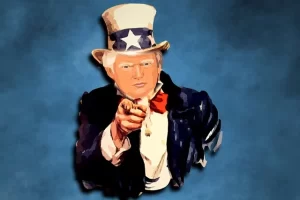 So Donald Trump just demanded control of Canadian ports—not a tariff adjustment, not a trade renegotiation, not a diplomatic proposal sent through back channels and discussed behind closed doors—a direct public, on-camera demand that Canada surrender operational authority over its sovereign port infrastructure to the United States.
His exact words: “Canada’s ports are critical to American commerce, and it’s time they were managed in a way that reflects that reality—under American oversight, with American standards, serving American interests first.”
A sitting American president just demanded operational control of another sovereign nation’s ports. Ports that belong to Canada, that sit on Canadian soil, that are governed by Canadian law, and that have been built, maintained, and operated by Canadians for over a century.
Mark Carney’s response wasn’t diplomatic. It wasn’t calibrated. It wasn’t the cold, analytical, chess-move precision that had defined his previous confrontations with the White House.
Within 48 hours, Canada redirected port capacity away from American shipping, signed emergency preferential access agreements with the European Union and four Asian economies, and announced a $12 billion Arctic port expansion that explicitly excluded American commercial participation.
Warren Buffett called it the most expensive negotiation mistake he had witnessed in 70 years of business—and then explained the one principle that every first-year negotiation student learns, and that the White House apparently never heard:
Never make a demand that reveals how badly you need what you’re asking for.
But it’s what Carney said—seven words delivered directly into the camera—that are now being quoted in every foreign ministry and every negotiation classroom in the world that tells you this isn’t a trade dispute anymore.
When you hear what Trump specifically demanded, why Carney’s refusal was actually a trap that inverted the entire power dynamic, and what happens to every American product that moves through Canadian waters, you’ll understand why this isn’t a bad week for American trade.
This may be the moment the world discovered who actually holds the leverage on this continent.
Let me take you through exactly what Trump demanded, because the specifics reveal something that changes the entire calculus of this confrontation.
The demand was made at a press conference in the White House Rose Garden. Unprompted—not in response to a question—Trump looked into the camera and said:
“Canada has some of the most important ports in North America—and frankly in the world—and they’re not being run in a way that benefits the United States. We send billions and billions of dollars’ worth of goods through those ports, and we have no say in how they’re managed. No oversight. No priority access. That’s going to change.
Going forward, the United States will require operational oversight of key Canadian port facilities, including Vancouver, Montreal, Halifax, and Prince Rupert. And American commercial shipping will receive priority access and priority processing at all of them.”
The language was extraordinary in what it revealed.
“We have no say in how they’re managed.”
As though Canadian ports exist to serve American commerce.
“American commercial shipping will receive priority access.”
As though the purpose of Canadian sovereign infrastructure is to prioritise the needs of a foreign nation.
“That’s going to change.”
Not a request. Not a proposal. A declaration—issued unilaterally, without negotiation, without consultation with the Canadian government, and without any legal framework that could justify a sovereign nation demanding operational control of another sovereign nation’s infrastructure.
This was not trade policy.
Trade policy involves tariff rates, import quotas, regulatory standards, dispute resolution mechanisms.
This was a demand for physical control of foreign sovereign assets—ports, terminals, shipping lanes, inspection facilities—that belong to Canada, the way American ports belong to the United States.
Behind the scenes, the pressure extended further than the public statement.
Reports emerged within hours that the U.S. Trade Representative had delivered a formal memorandum to the Canadian ambassador outlining the specific terms of the proposed oversight framework—a 37-page document detailing:
- American inspection authority at Canadian terminals
- American veto power over port scheduling decisions
- American priority queuing for commercial vessels
- A requirement that Canadian port authorities submit operational plans to a joint committee with an American-appointed chair
The memorandum had been drafted weeks in advance. The public demand was the pressure point. The private document was the architecture of control.
One Canadian trade official who reviewed the memorandum said:
“This isn’t an oversight framework. This is a colonial administration document.”
They’re describing the governance structure of a territory, not a trade partnership with a sovereign nation.
The Trump administration also communicated through intermediaries that the demand was non-negotiable—and that failure to comply would trigger what one senior adviser called a “complete restructuring” of the bilateral trade relationship.
Language that trade analysts immediately interpreted as a threat of comprehensive sanctions targeting Canadian exports to the United States.
American lobbyists in Ottawa approached Canadian Port Authority executives suggesting that cooperation would unlock significant American infrastructure investment, while resistance would result in an economic realignment Canada cannot afford.
The public statement was the visible pressure. The private campaign was a coordinated effort to coerce compliance through economic threats, political pressure, and the implicit promise that submission would be rewarded while resistance would be punished.
The pattern was identical to the logic of every imperial demand in history:
Give us control of your infrastructure voluntarily, or we will make the cost of refusal unbearable.
And he genuinely believes he is the best person to become Planet Earth’s default leader!!
In fact a TOP WORLD LEADER in perpetuity …
SOUNDS JUST LIKE PUTIN AND HIS CONTROL OVER RUSSIA
BOSUM BUDDIES ?